

The global conversation around mental health is shifting fast. Many people want the deep, transformative results associated with altered states of consciousness but face significant roadblocks. Legal restrictions, professional licensing risks, and prolonged regulatory delays keep traditional psychedelic substances out of reach for the vast majority of Canadians.
Fortunately, the human body carries its own built-in mechanism for accessing these profound therapeutic states. Through specific breathing protocols, you can experience deep emotional release, vivid imagery, and transpersonal insights completely independent of external chemistry.
What Is Psychedelic Breathwork?
The term psychedelic breathwork refers to specialized, fast-paced breathing techniques designed to induce non-ordinary states of consciousness for therapeutic healing. While modern wellness trends popularize short breathing exercises for stress relief, this method involves sustained, rhythmic breathing over an extended period.
The roots of this practice stem directly from transpersonal psychology. When clinical research into psychedelic substances was halted globally in the late twentieth century, pioneering psychiatrists looked for alternative pathways to the unconscious mind. They discovered that hyperoxygenation acts as a natural key to the same inner healing intelligence that plant medicines activate.

The Grof Legacy and Non-Ordinary States
Dr. Stanislav Grof and Christina Grof systematized this work after observing thousands of psychedelic sessions. They realized that changing the rhythm of respiration allows unconscious trauma, birth memories, and spiritual archetypes to surface naturally.
Today, this framework forms the foundational curriculum at the Grof Psychedelic Training Academy. It offers a structured approach to healing that honors the inner wisdom of the participant. Instead of directing the experience from the outside, facilitators create a safe space where the body and mind can process stored tension on their own terms.
Can Breathwork Feel Like Psychedelics? The Science Explained
Many people approach this modality with skepticism, wondering: can breathwork feel like psychedelics in a verifiable, tangible way? The short answer is yes. While the onset and sensory presentation differ, the psychological depth and neurological mechanisms share striking similarities.
When you engage in continuous, deep respiration, you alter the ratio of oxygen to carbon dioxide in your bloodstream. This process, known as voluntary hyperventilation, causes mild respiratory alkalosis. The blood becomes slightly more alkaline, which temporarily changes how oxygen binds to hemoglobin and influences cerebral blood flow.
The Neurological Shift of Breathwork
- Phase 1: Continuous Deep Respiration
Sustained, rapid breathing increases oxygen levels and shifts blood chemistry. - Phase 2: Respiratory Alkalosis
Blood becomes slightly more alkaline, naturally altering cerebral blood flow. - Phase 3: Quieting the DMN
The brain’s Default Mode Network drops in activity, softening ego boundaries. - Phase 4: Transpersonal States
Unconscious material and deep somatic healing surface without substances.
Quieting the Brain’s Control Center
From a neurological standpoint, both classical psychedelics and rhythmic breathing target the Default Mode Network (DMN). The DMN is a network of interacting brain regions that acts as the conductor of your cognitive orchestra. It manages your ego, your sense of time, your autobiographical memory, and your habitual thought patterns.
When you quiet the DMN, the rigid boundaries of the ego begin to soften. This reduction in top-down cognitive control allows long-buried memories, unexpressed emotions, and creative insights to rush into awareness. You can read a detailed breakdown of how this bodily shift creates space for profound psychological breakthroughs on the Inner Summits analysis of breathwork tools.
Physical Signs of Somatic Release
Because this process is entirely physical, it addresses a major gap in traditional talk therapy: the lack of somatic tools. Trauma does not just exist as a thought in the mind; it stores itself in the muscular tissue and nervous system of the body.
During a session, participants frequently experience distinct physical phenomena:
- Carpopedal spasms (temporary tingling or tightness in the hands and feet)
- Intense temperature fluctuations or shivering
- Spontaneous vocalizations, crying, or laughing
- Trembling and shaking as chronic muscular armor relaxes
These physical responses represent the nervous system discharging trapped survival energy. Talk therapy often loops around the intellectual story of trauma, whereas breathwork allows the body to complete the physical stress response cycle that was interrupted during the original traumatic event.
Solving Regulatory and Professional Hurdles for Clinicians
For mental health professionals in Canada, the current therapeutic environment is challenging. The excitement surrounding psychedelic-assisted psychotherapy is met with strict regulatory boundaries, long approval processes, and legal uncertainty.
Bypassing the Legal Wait Times
Many practitioners find themselves stuck in what experts call the “psychedelic winter.” They see the clinical data supporting these modalities but cannot legally offer psilocybin or MDMA to their clients without rare exemptions.
Mastering breathwork allows clinicians to offer experiential, transpersonal therapy immediately. It requires no government exemptions, carries no risk of criminal liability, and operates completely within a legal framework. Practitioners can expand their clinical toolkits today rather than waiting years for federal policy shifts.
Managing Client Safety and Medical Risk
Another massive benefit of this breath-driven approach is the element of autonomy. When a patient ingests a psychoactive compound, they are committed to a chemical journey that lasts anywhere from four to twelve hours. If the experience becomes overwhelming, they cannot easily turn it off.
With breathwork, the participant retains full control over the volume of the experience:
- To deepen the altered state, the participant intensifies and quickens their breathing rhythm.
- To slow down or ground the experience, the participant simply returns to a normal, resting breath.
- Within minutes of normalization, the blood chemistry stabilizes, and the ordinary state of consciousness returns.
This safety profile mitigates the professional risks that make many conservative therapists hesitant to engage with non-ordinary states. It provides a predictable, self-regulated container for deep psychological work.
How a Breathwork Session Works Without Drugs
A professional session looks vastly different from a typical meditation class. It is a highly structured, immersive event that lasts several hours, requiring specialized preparation and environmental design.
The Power of Music and Group Containment
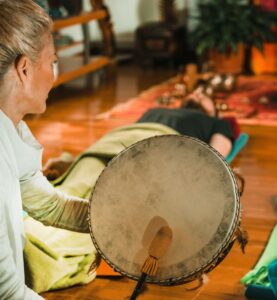
Music is not background noise in this modality; it is an active co-facilitator. Sessions utilize carefully arranged musical arcs designed to mirror the classic trajectory of a psychedelic journey.
The session structure generally flows through predictable phases:
- An initial phase of driving, rhythmic drumming or fast pacing to stimulate the breathing rhythm.
- A peak phase featuring dramatic, orchestral, or emotionally evocative music to support breakthrough experiences.
- A resolution phase with meditative, soothing sounds to encourage grounding and stillness.
Participants usually work in pairs, swapping roles between the “breather” and the “sitter.” This setup ensures that every breathing participant has the undivided attention of a focused peer, backed by certified professional instructors who oversee the room.
Integrating the Transpersonal Experience
The work does not end when the music stops. Transforming a non-ordinary experience into lasting behavioral change requires conscious integration.
Immediately following a session, participants use expressive artwork, such as drawing mandalas, to capture the non-linear insights of their journey. This is followed by small-group sharing circles where individuals begin putting verbal language to transpersonal experiences.
For individuals interested in learning how to facilitate these deep containers safely, checking out the upcoming program dates on our course portal is an ideal next step. If you want to view our full curriculum of experiential modules, you can browse through the Grof Academy course collections to find a training track that aligns with your professional background.
Ultimately, the human breath proves that the capacity for mystical states, profound trauma resolution, and spiritual rebirth is inherent to our biology. You do not need to wait for legislative changes or take substances to access the deep chambers of your psyche. The gateway is already yours, waiting right under your nose.
FAQs
Is psychedelic breathwork safe for everyone?
No. Because the technique induces temporary respiratory changes and emotional release, it is contraindicated for individuals with severe hypertension, glaucoma, aneurysm, epilepsy, severe cardiovascular issues, or active psychosis. Always complete a medical screening before participating.
Can you actually experience hallucinations just from breathing?
Yes. While these are usually experienced as internal imagery, dream-like sequences, or archetypal symbols rather than external visual distortions, the vividness can match the intensity of substance-induced states.
How long does a typical session last?
A complete therapeutic session generally takes between two to three hours of continuous breathing, supplemented by pre-session preparation and post-session integration work.
Do I need a clinical background to train in this modality?
While many students are therapists, psychologists, and medical workers, training programs are open to dedicated individuals looking to master somatic space-holding and transpersonal psychology principles.