
A profound breathwork or psychedelic experience can open doors to deep parts of the psyche. You might encounter vivid archetypal realms, relive biological birth sequences, or feel immense energetic shifts in your body.
Then the session ends and ordinary reality returns.
Many people face a frustrating barrier during the days that follow. They know something monumental occurred, but they cannot explain it to a therapist or friend.
The mind craves order, yet the experience resists labels. This friction points to a critical need for bodily grounded processing methods.
The Ineffability Problem: When Words Fail the Journey
The primary challenge of deep psychological work is that altered states operate beyond standard language. Psychedelic sessions and holotropic breathwork engage the oldest, most instinctive parts of our biology.
These areas process reality through symbols, physical feelings, and raw emotion rather than structured syntax.
Why the Left Brain Struggles Post-Session
The left hemisphere of the brain manages logic, timelines, and speech. When you try to force a multidimensional experience into a chronological narrative, the true meaning often dissolves.
You might find yourself saying, “I saw colors, but that does not capture what it felt like.” This gap can leave you feeling isolated or disconnected from your own breakthrough.
Bypassing Intellectual Defense Mechanisms
Talk therapy is incredibly useful, but it can accidentally encourage intellectualization. It is easy to talk about an experience to avoid actually feeling the residual energy left in your muscles and nervous system.
Non-verbal tools allow you to express the exact texture of your experience without your inner critic rewriting the story.
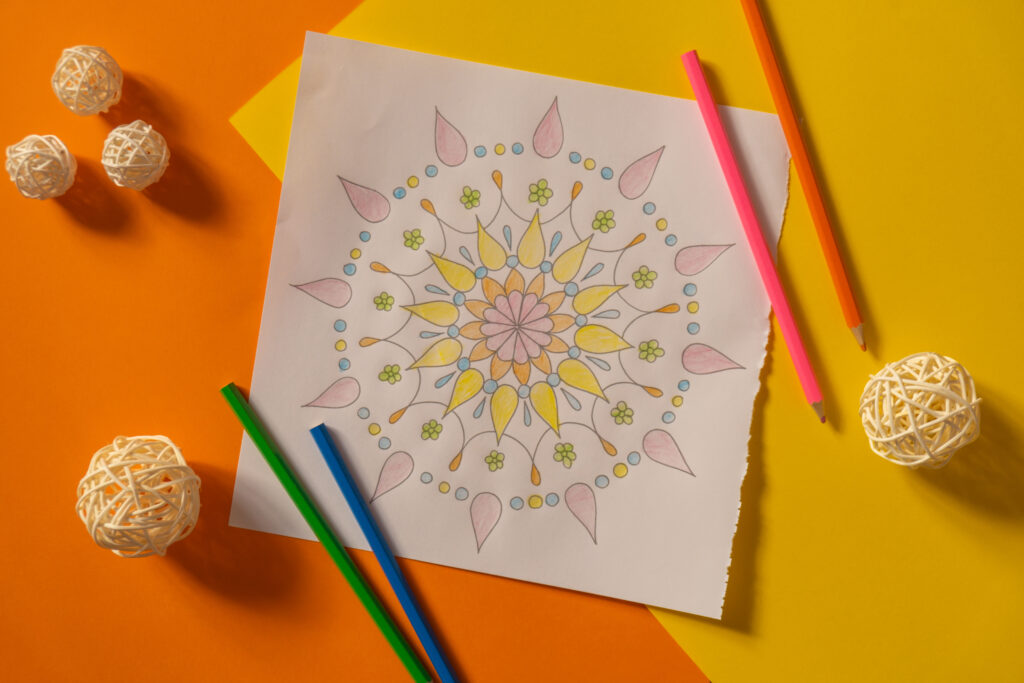
Mandala Art for Emotional Healing as a Geometric Container
The word mandala comes from ancient Sanskrit, translating simply to “circle.” In transpersonal work, drawing within a circular boundary serves a precise clinical purpose. It bridges the gap between chaotic inner states and grounded, physical reality.
Using mandala art for emotional healing provides an immediate psychological anchor for turbulent memories.
Jung, Grof, and the Sacred Circle
Carl Jung noticed that when his patients were going through severe psychic reorganization, they automatically began drawing circles. Decades later, Dr. Stanislav Grof integrated this practice into his breathwork workshops.
Both pioneers recognized that the circle represents the self, a unified whole that remains intact even when individual pieces feel broken.
Creating a Boundary for Psychological Fragmentation
When a session unearths difficult material, you might feel wide open or ungrounded. The circle functions as a protective fence.
Everything you felt – no matter how frightening, ecstatic, or confusing- is placed inside that boundary. It cannot bleed out into your work week or overwhelm your daily tasks.
Practices for Anchoring Body-Based Insights
True somatic integration means acknowledging that the body remembers what the mind tries to forget. Traces of your journey might linger as a tightness in the chest, a buzzing in the hands, or a sense of profound lightness.
Art making translates these internal physical currents into visible, external forms.
Moving from Physical Sensation to Color and Form
Before picking up a drawing tool, sit quietly and scan your body. Identify where the memory of your journey lives right now.
- Is it a heavy blue weight in your stomach?
- Is it a sharp yellow streak behind your eyes?
- Is it a warm, expanding green radiation in your heart?
Do not worry about making a beautiful picture. Focus entirely on matching the color and pressure of the oil pastel to that specific internal sensation.
Setting Up Your Sacred Integration Space
Your environment changes how your nervous system processes information. Find a quiet corner where you will not be interrupted for at least forty minutes.
Turn off your phone notifications and lower the lighting if bright glare feels agitating. You are creating an extension of the safe space you experienced during your actual session.

Steps to Create Your Integration Mandala
You do not need any artistic training to use this method effectively. In fact, having no artistic background is often an advantage because you have fewer expectations to manage.
- Draw a large circle using a plate or compass.
- Close your eyes and recall your session’s somatic core.
- Select colors instinctively based on current body feelings.
- Fill the circle from the center outward, or vice versa.
- Sit back, observe the image, and write a single title.
Preparing Your Materials and Mindset
Gather a large sheet of blank paper, a circular object like a dinner plate to trace, and a box of oil pastels or soft charcoal. Trace the circle clearly onto the center of your page.
Take three deep, grounding breaths. Remind yourself that this is an act of release, not an art competition.
Externalizing the Unspoken Energy
Place your pastel on the paper and let your hand move without planning the final image. You might find yourself drawing chaotic zigzags, thick blocks of dark color, or delicate repeating patterns.
Keep your focus inside the circle. If your mind starts judging the work, gently bring your attention back to the physical feeling of the pastel moving across the paper texture.
Once you finish, look at the page and notice how your body feels. Often, a distinct sense of relief or lightness occurs because the energy has shifted from your inside world out onto the paper.
To build ongoing wellness habits alongside your creative work, consider reviewing practical tips on consistent journaling routines to maintain momentum.
Facilitator Tools: Guiding Others Through Expression
If you work as a therapist, medical professional, or guide, adding non-verbal tools to your practice protects your clients from premature intellectualization.
| What to Do | What to Avoid |
| Ask about bodily feelings. Invite the client to track physical sensations connected to the colors and lines. | Interpret the symbols yourself. Avoid assigning fixed psychological meanings to their art choices. |
| Validate abstract shapes. Confirm that scribbles, chaotic marks, or empty spaces are completely valid expressions. | Force a linear story too soon. Allow the non-verbal imagery to sit before demanding a logical timeline. |
| Focus on the drawing process. Ask how it felt to move the pastel across the page rather than focusing on the result. | Judge the artistic quality. Keep the space free of praise or critique regarding technical artistic skill. |
Supporting Clients in the Critical Post-Session Window
The hours and days immediately following a holotropic or psychedelic state are highly plastic. The brain is uniquely receptive to forming new pathways.
Providing a box of pastels right after a person opens their eyes allows them to lock in their insights before the rational mind can minimize them.
To deepen your understanding of these non-verbal transpersonal frameworks, you can learn more about our historical lineage and approach to guiding expanded states safely.
If you are ready to expand your professional toolkit, explore our specialized transpersonal training courses designed for clinicians and dedicated facilitators seeking certification in these somatic arts.
FAQs
What if I cannot draw or consider myself uncreative?
You do not need any artistic skill. The goal is not to create a masterpiece but to move emotional energy out of your body onto paper. Simple lines, solid blocks of color, or chaotic scribbles are completely valid expressions of your inner state.
How soon after a session should I draw a mandala?
The best window is within the first twenty-four to seventy-two hours post-session while the somatic memories are still fresh. However, drawing a mandala weeks later can still help you reconnect with a journey that feels like it is fading.
What should I do with my mandala once it is finished?
Keep it in a private journal or a secure folder. You do not need to display it. Some people find value in looking back at their drawings months later to track patterns in their psychological growth and healing cycles.
Can mandala drawing replace traditional integration therapy?
No, it works best as a complementary tool. It assists with the non-verbal phase of processing, making your eventual conversations with a specialized integration professional far more focused and effective.